Inquest into Lula Landry's death
The Cuckoo's CallingThe inquest into Lula Landry's death established the official interpretation of her fall as suicide, but its reasoning and evidentiary limits become central to Strike’s investigation. Lula’s bipolar disorder and past difficulties dominated how the police and coroner understood her death; meanwhile, accounts of her recent mood, the Bestiguis’ testimony, and the physical details of the scene left room for doubt. The inquest is therefore both a judicial conclusion and a record whose omissions and assumptions Strike must examine.
The official conclusion and its assumptions
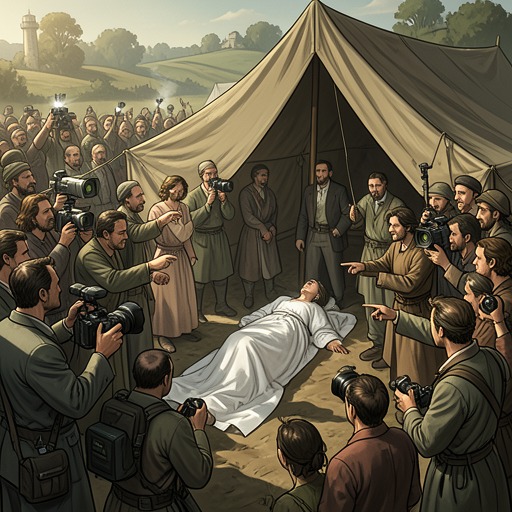
The inquest followed an intensely public death. Strike recalls television coverage of Lula’s body being carried to an ambulance amid photographers and camera flashes. The coverage had made the public unusually familiar with the case, but familiarity was not the same as reliable judgment: people could become opinionated about the evidence before they were in a position to assess it impartially.
John Bristow tells Strike that the detective in charge had been convinced from the outset that Lula had killed herself because she was taking lithium. Bristow argues that the investigation overlooked matters that later attracted notice online. His objection identifies the inquest’s defining weakness as he sees it: a medical history had become an interpretive frame through which the evidence was read, rather than one fact among several to be weighed.
The account Bristow gives of Lula’s history is complicated rather than exculpatory. After her father’s death, she was expelled from school for experimenting with drugs, ran away to London, and was found living rough with addicts. Drug use worsened her mental-health problems, and she left a treatment centre without permission. Eventually, she was diagnosed with bipolar disorder and given medication. Bristow says that when she took her tablets, she seemed well; the coroner accepted that she had been taking them, and the autopsy confirmed it. Medication compliance, however, could not by itself settle whether she had died by suicide.
The dispute over Lula’s state of mind
Bristow rejects the idea that Lula was depressed before her death. He says he saw her on the preceding morning and found her apparently well, with her career in an unusually promising position. She had signed a contract expected to bring in five million over two years, asked him to review its terms, and had months of work booked, including a shoot in Morocco that she was looking forward to. For him, these circumstances made suicide seem inexplicable.
Strike does not treat outward optimism as proof of safety. His experience has taught him that someone can appear engaged with future plans without intending to live into them; he recalls a soldier who had seemed lively at his birthday party before dying by suicide later that night. The recollection supplies a counterweight to Bristow’s argument, not a diagnosis of Lula’s state. The inquest’s central dispute thus remains difficult: a promising future and an apparently good morning are relevant observations, but neither establishes what Lula felt later.
Rochelle Onifade’s later account echoes the diagnostic language surrounding the case from another position. She says Lula was depressed and compares the illness to her own, describing it as something that can take hold. The word comes out as “nillness,” a slip that briefly redirects Strike’s attention to how illness can shade into nothingness. Her statement does not resolve the question of Lula’s state of mind; it shows how depression could be treated by people who knew Lula as a lived affliction, even as other witnesses disputed whether it explained her death.
The Bestiguis’ testimony and the sound dispute
Tansy Bestigui’s account was an important point of contention. She claimed to have heard an argument upstairs, including Lula’s cry, “You’re too late,” and a man’s reply, “You’re a fucking liar.” Eric Wardle tells Strike that the police regarded these reported words as auditory hallucinations associated with Tansy’s cocaine use. He says the police tested whether the voices could have carried between the flats: the windows were designed to keep outside noise out, and an officer shouting from Lula’s balcony could not be heard by sober listeners in the flat below. On that basis, the police concluded that Tansy could not have heard what she claimed to hear.
The police account did not eliminate every question about Tansy’s circumstances. In the file, Strike notes cocaine on the side of the bath and focuses on the moments after she saw Lula fall. He also observes that Tansy consistently maintained that Freddie Bestigui was in bed asleep when Lula fell, despite her shifting versions of other details. Strike recalls her shielding her face while he pressed her on that point. Without a map of the flat, the positions of both Bestiguis at the crucial moment remained, in his view, unproven. His reading does not establish what either person witnessed; it shows why the written record could not simply be treated as a complete reconstruction.
The scene as a problem of reconstruction
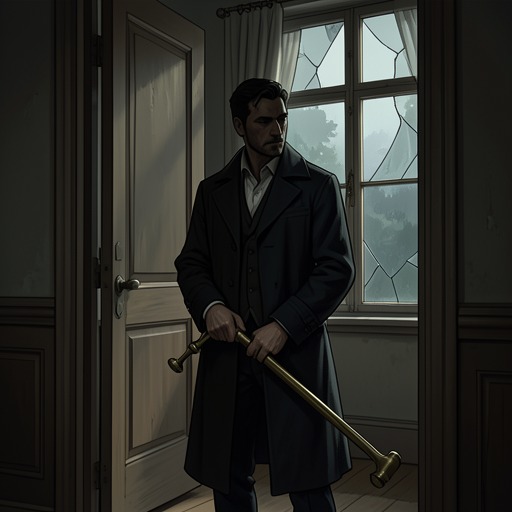
Other evidence later gives Strike reason to revisit the investigation’s account of events inside the building. Derrick Wilson, the security guard who entered Lula’s flat, recalls taking the master key and running upstairs after telling the Bestiguis to call the police and watch the lift. He describes entering the flat without finding anyone on the stairwell. When Strike later asks him to demonstrate the order in which he searched the rooms, Wilson remembers that he slipped backwards on the stairs, where there were drops of water. The recovered detail connects the guard’s route to a physical trace that had not been prominent in his initial recollection.
The drops acquire a possible explanation when Strike reconstructs John Bristow’s movements. He proposes that Bristow took white roses from a vase in Flat Two, dried their ends, and carried them upstairs to Lula’s flat, leaving a few drops of water behind. The flowers offered a way to approach Lula: seeing the roses through the peephole, she could have believed her long-lost brother had arrived and opened the door. This reconstruction turns an apparently minor trace into part of an account of how Bristow gained entry, while Wilson’s remembered slip supplies a connection between the object and the route through the building.
Consequences and significance
The inquest’s conclusion did not end the dispute over Lula’s death. For Bristow, the investigation’s reliance on her mental-health history obscured evidence that might have challenged suicide. For Strike, neither a history of bipolar disorder nor a witness’s confidence can substitute for testing what people could hear, where they were, and how events could have unfolded. The case demands a distinction between direct observation, interpretation, and later recollection.
That distinction also exposes the limits of an official account assembled from statements and assumptions. The reported argument was rejected after a sound test; the Bestiguis’ exact positions remained uncertain to Strike; and Wilson’s recollection of water on the stairs surfaced only when he physically retraced his search. The inquest’s significance lies not in furnishing a final answer, but in making the accepted answer consequential: once Lula’s history had been treated as an explanation for her death, seemingly contradictory details risked being discounted before they had been fully examined.